Microsoft Dynamics 365 Customer Engagement:
A Reference Architecture for Financial Services Institutions
Delivering Trusted, Compliant, and Intelligent Client Experiences
In financial services, customer experience is inseparable from trust. Whether the interaction occurs in a branch, through a relationship manager, or via a digital channel, institutions must balance personalization with regulatory rigor, data privacy, and operational resilience.
Microsoft Dynamics 365 Customer Engagement (CE), built on the Power Platform with Microsoft Dataverse and integrated with Microsoft 365, and optionally Microsoft Fabric, provides financial institutions with a modern reference architecture that does exactly that, connecting client engagement, compliance, and intelligence on a single, governed platform.
This architecture enables banks, insurers, and capital markets firms to move from fragmented client data and disconnected processes to a unified, auditable, and insight‑driven operating model.
Dynamics 365 Customer Engagement supports core client‑facing functions across the financial services lifecycle:
- Sales and Relationship Management for commercial, and wealth clients
- Client Service and Case Management aligned to SLAs and regulatory obligations
- Client Onboarding, and Lifecycle Events
- Targeted Marketing and Client Communications
What differentiates Dynamics 365 CE in financial services is not just functionality, it is the underlying platform architecture that ensures controls, organization, reduced complexity, transparency, and scale.
The Common Data Universe, “Dataverse” = The Trusted Client Data Backbone
At the heart of the architecture is Microsoft Dataverse, serving as the operational system of record for client engagement data.
For financial institutions, Dataverse provides:
- A canonical client data model across accounts, account hierarchies, households, contacts, relationships, products, and interactions
- Granular security controls, including row‑level and field‑level access to protect PII information
- Full auditability, supporting regulatory and internal compliance requirements
- Policy‑driven business logic, ensuring consistent execution of onboarding, servicing, and escalation processes
Dataverse becomes the “single version of the truth” for client engagement—controlled, governed, and resilient.
Integration with Microsoft 365: Secure Productivity for Front Office Teams
Relationship managers, advisors, and service agents like to live in Outlook or Teams or Excel or all three. Dynamics 365 CE integrates client data directly into these tools while maintaining compliance boundaries.
Examples include:
- Outlook and Teams integration for secure client communications and internal collaboration linked to client records
- Excel integration for controlled analysis and data updates, without exporting sensitive data unmanaged
- Document management with retention and compliance policies enforced
This integration improves productivity while ensuring that interactions remain traceable and compliant.
Azure Data Lake: Analytical Scale Without Risk
Operational systems like Dataverse are designed for transaction integrity, not massive analytical workloads. To meet regulatory reporting, risk analysis, historical point in time analysis, and other advanced analytics needs, data is replicated to Azure Data Lake using Dataverse Synapse Link.
This enables:
- Near‑real‑time replication of client engagement data
- Secure, read‑only analytical copies of operational data
- No performance impact on client‑facing systems
For financial services, this separation is critical. It ensures that reporting, risk modeling, and analytics never compromise operational stability or data integrity.
Microsoft Fabric: Intelligence, Risk Insight, and Regulatory Reporting
Microsoft Fabric provides a unified analytics and AI platform built directly on Azure Data Lake. In Dynamics 365 architecture, Fabric powers even more enterprise intelligence.
Key financial services use cases include:
- Client profitability and relationship analytics
- Conduct risk and service quality monitoring
- Regulatory reporting and supervisory analytics
- Advanced AI and predictive modeling, responsibly governed
Fabric enables institutions to move beyond static reporting toward continuous insight—all while maintaining lineage, governance, and security.
Power Platform: Controlled Agility
Across this architecture, the Power Platform enables innovation without sacrificing control and it supports the constant change of technology so Enterprise Accounts don’t fall behind. We also get
- Power BI which delivers trusted dashboards to executives and regulators
- Power Automate which orchestrates exception handling, business process automation and cross‑system workflows
- Power Apps which can extend customer engagement processes, subset features into department specific needs and safely and efficiently deliver results
This allows financial institutions to adapt quickly to regulatory change and evolving client expectations.
High Level Architecture
The diagram below illustrates how these capabilities come together in a financial services context where you might have people outside of the enterprise accessing and offering a subset of data through Power Page Portals and where inside the Enterprise people are using Single Sign on authentication and leveraging off of Microsoft 365 Office with Microsoft Dynamics 365 Customer Engagement Apps.
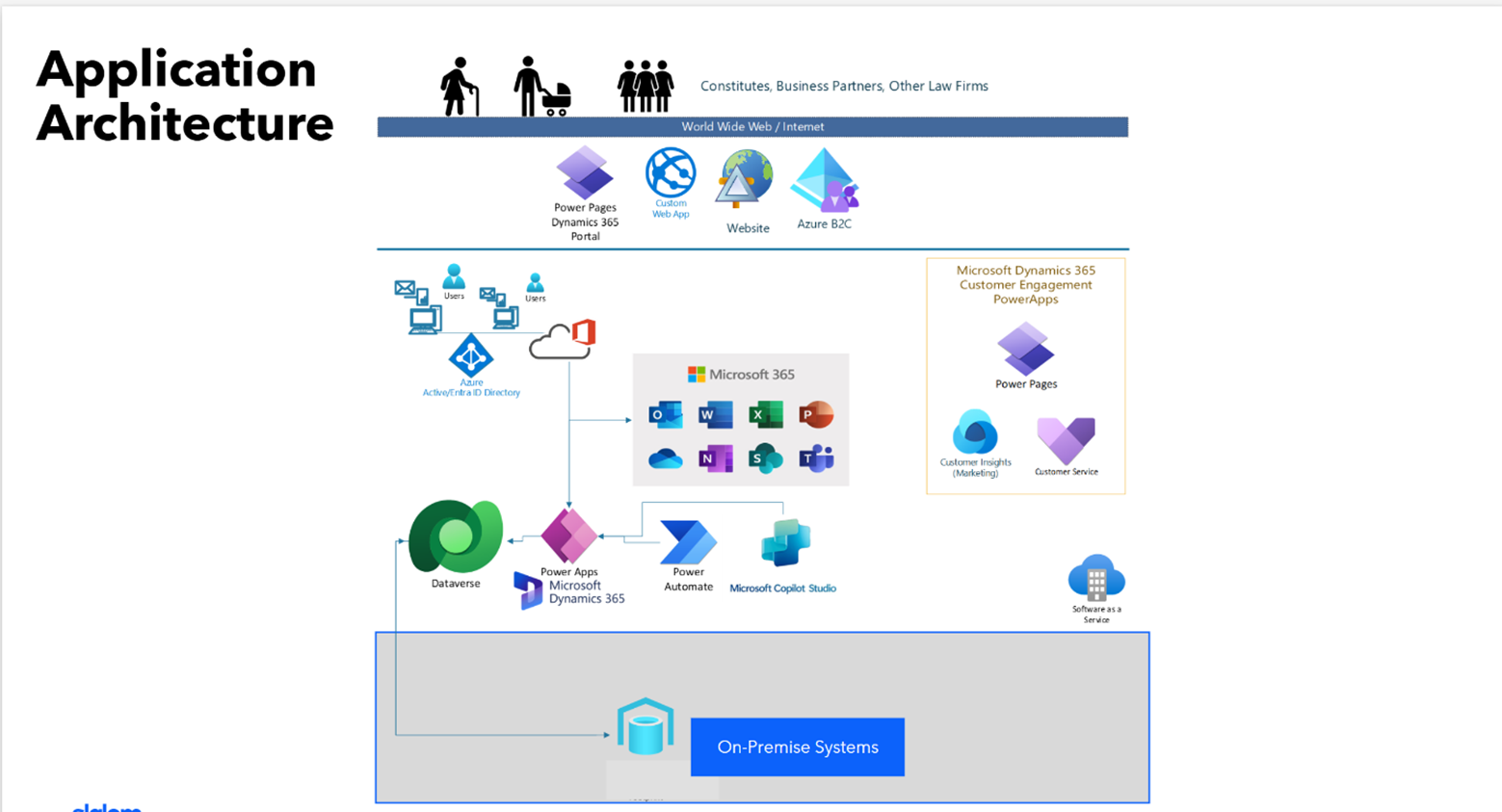
Flow Overview:
- Client interactions occur across branches, contact centers, and digital channels
- Dynamics 365 CE orchestrates engagement and process execution
- Dataverse serves as the secure, auditable system of record
- Microsoft 365 enables compliant productivity and collaboration
- Azure Data Lake and/or Microsoft Fabric deliver analytics, AI, and regulatory insight
Why This Architecture Matters for Financial Leaders
From an executive perspective, this architecture enables:
- Client‑centric growth without compromising compliance
- Regulatory confidence through auditable, governed data flows
- Operational resilience via clear separation of transactional and analytical workloads
- AI readiness grounded in trusted, secure data
In an era where regulators, clients, and markets demand both transparency and intelligence, this is not just a technology architecture—it is a strategic advantage.
Final Thought
Financial institutions that modernize client engagement on Dynamics 365, Dataverse, Microsoft 365, Azure Data Lake, and Fabric are not simply upgrading CRM systems. They are establishing a platform for trusted growth—where every client interaction is compliant, contextual, and informed by real‑time insight.
If you’d like, I can:
- Adapt this article for banking vs. insurance vs. wealth management
- Add Copilot and AI scenarios specific to financial services
- Create a board‑ready version focused on risk, ROI, and transformation outcomes
 Field Notes
Leave a comment